> ## Documentation Index
> Fetch the complete documentation index at: https://docs.suprsend.com/llms.txt
> Use this file to discover all available pages before exploring further.
# HMAC Authentication
> Generate HMAC signatures to securely authenticate users and subscriber IDs in headless Inbox implementations, covering hash keys, payloads, and code samples.
**For React/Web apps, use JWT authentication instead.** The `@suprsend/react` (drop-in) and `@suprsend/react-core` / `@suprsend/web-sdk` (headless) SDKs authenticate users with signed JWTs — see the [client authentication guide](/docs/client-authentication) and the [React migration guide](/docs/react-migration-guide).
This page documents the legacy HMAC `subscriber_id` flow that is still used by the React Native (`@suprsend/react-headless`) and Flutter Inbox SDKs. Do **not** use this for new React/Web integrations.
## Why HMAC authentication is required?
When you initialize SuprSend's Inbox on your website, you provide your SuprSend workspace API Key and a user's distinct id. A savvy user can obtain this API Key with this setup and can initialize the inbox on their website with your API Key but with a different distinct id and start viewing that user's notifications.
With HMAC authentication, an SHA-256 HMAC string (`subscriber_id`) is generated for each `distinct_id` and prevents unauthorized access to Inbox service by just spoofing `distinct_id`.
## How to generate subscriber\_id?
Use the below function in your server-side code to generate a unique unguessable `subscriber_id` using your `distinct_id` and **inbox-secret** (picked from the Inbox Vendor Integration page).
* `subscriber_id`is unique to each`distinct_id`and should be generated for each user.
* Inbox Secret is the`Shared Secret`key available in your[Inbox vendor page](https://app.suprsend.com/en/production/vendors/inbox/suprsend-inbox). This key is unique to your workspace and should not be shared with anyone for security purposes
```python python theme={"system"}
import base64
import hashlib
import hmac
def hmac_rawurlsafe_base64_string(distinct_id: str, secret: str):
digest = hmac.HMAC(secret.encode(), msg=distinct_id.encode(), digestmod=hashlib.sha256).digest()
encoded = base64.urlsafe_b64encode(digest).decode()
return encoded.rstrip("=")
```
```go go theme={"system"}
package main
import (
"crypto/hmac"
"crypto/sha256"
"encoding/base64"
)
func HmacRawURLSafeBase64String(message, secret string) string {
hash := hmac.New(sha256.New, []byte(secret))
hash.Write([]byte(message))
return base64.RawURLEncoding.EncodeToString(hash.Sum(nil))
}
```
```javascript Node theme={"system"}
import crypto from "crypto";
// node versions >= v15.7.0, v14.18.0
function hmac_rawurlsafe_base64_string(distinct_id, secret) {
const hash = crypto
.createHmac("sha256", secret)
.update(distinct_id)
.digest("base64url");
return hash.replace(/=+$/, "");
}
// node versions < v15.7.0, v14.18.0
function hmac_rawurlsafe_base64_string(distinct_id, secret) {
return crypto
.createHmac("sha256", secret)
.update(distinct_id)
.digest("base64")
.replace(/\+/g, "-")
.replace(/\//g, "_")
.replace(/=+$/, "");
}
```
```java java theme={"system"}
package test;
import java.nio.charset.StandardCharsets;
import java.security.InvalidKeyException;
import java.security.NoSuchAlgorithmException;
import java.util.Base64;
import javax.crypto.Mac;
import javax.crypto.spec.SecretKeySpec;
public class TestHmacGeneratation {
public static void main(String[] args) throws Exception {
String distinct_id = "b8278572-2929-4af6-be2b-cdc2bc1f6256";
String secret = "IG-J8Wvf7M-w4ll13h53NJAMQQNHdUqFTSJ2JVAZl0s";
TestHmacGeneratation instance = new TestHmacGeneratation();
String output = instance.hmacRawURLSafeBase64String(distinct_id, secret);
System.out.println(output);
// prints dHBWYF4oV190o4j-e3eYxB-SCkeHnoaiofe8EmGk9JQ
}
private String hmacRawURLSafeBase64String(String distinctId, String secret) throws InvalidKeyException, NoSuchAlgorithmException {
Mac sha256mac = getSha256macInstance(secret);
byte[] macData = sha256mac.doFinal(distinctId.getBytes(StandardCharsets.UTF_8));
String hmacString = Base64.getUrlEncoder().withoutPadding().encodeToString(macData);
return hmacString;
}
private Mac getSha256macInstance(String secret) throws NoSuchAlgorithmException, InvalidKeyException {
final byte[] secretBytes = secret.getBytes(StandardCharsets.UTF_8);
SecretKeySpec keySpec = new SecretKeySpec(secretBytes, "HmacSHA256");
Mac sha256mac;
try {
sha256mac = Mac.getInstance("HmacSHA256");
sha256mac.init(keySpec);
} catch (NoSuchAlgorithmException e) {
throw e;
} catch (InvalidKeyException e) {
throw e;
}
return sha256mac;
}
}
```
```pgsql PL/pgSQL theme={"system"}
CREATE EXTENSION "pgcryto";
CREATE OR REPLACE FUNCTION hmac_rawurlsafe_base64_string(distinct_id VARCHAR, secret VARCHAR) RETURNS VARCHAR
LANGUAGE PLPGSQL AS $func$
DECLARE
hmac_string VARCHAR;
BEGIN
hmac_string = encode(hmac(distinct_id::TEXT, secret, 'SHA256'), 'base64');
hmac_string = replace(replace(hmac_string, '+', '-'), '/', '_');
hmac_string = RTRIM(hmac_string, '=');
RETURN hmac_string;
END;
$func$;
```
It is imperative that the inbox secret is stored safely on your server side and not exposed to client-side code.
**NOTE:**
The subscriber\_id must be generated by server-side code (not in browser)
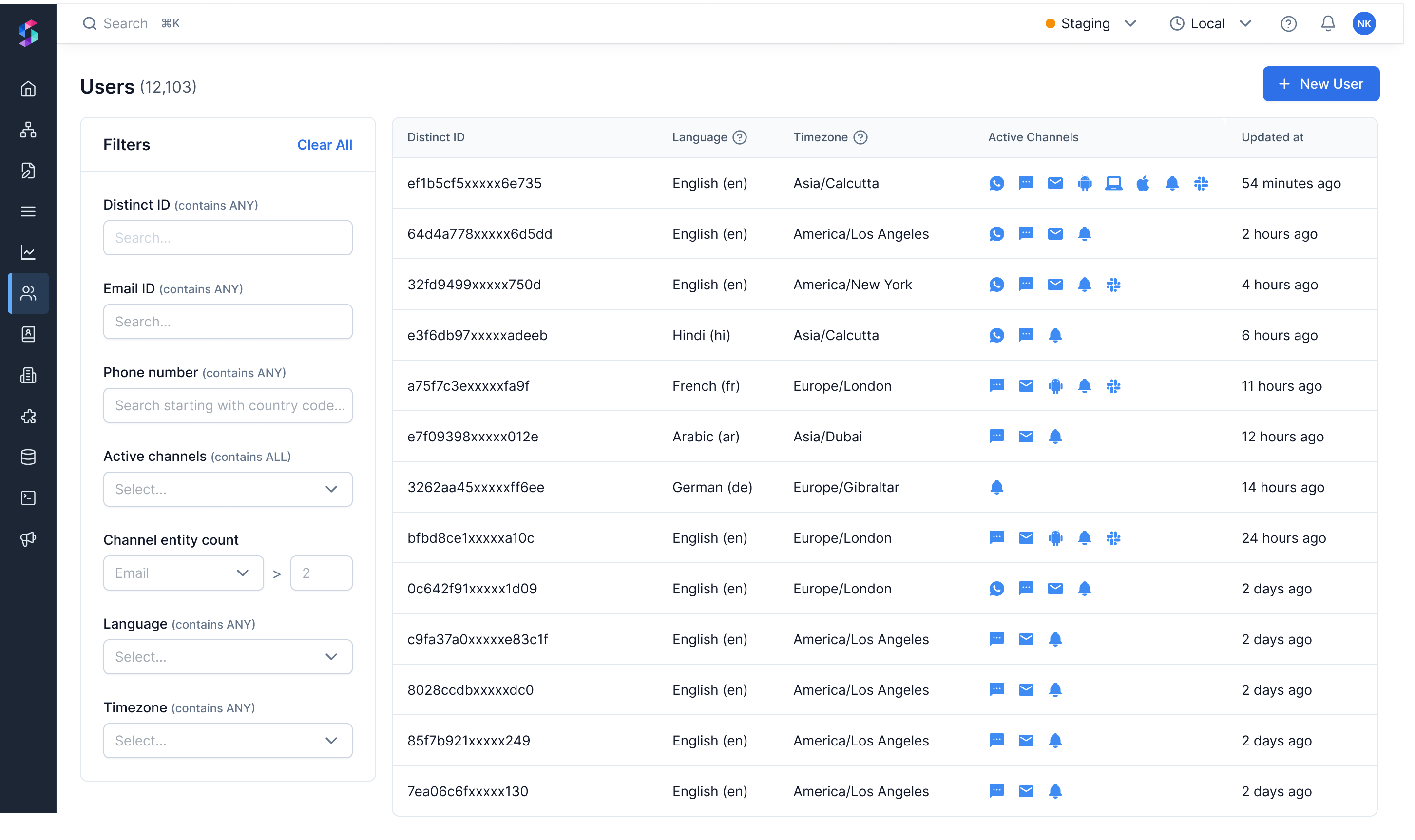
Even after setting up the inbox, if you are not able to see notifications then cross-check if your subscriber\_id mentioned is exactly correct by opening the user's tab in the Suprsend dashboard.
 ***
***