> ## Documentation Index
> Fetch the complete documentation index at: https://docs.suprsend.com/llms.txt
> Use this file to discover all available pages before exploring further.
# Trigger a workflow from the Node.js SDK
> Use the SuprSend Node.js SDK to trigger a workflow directly from your application code, with examples for the workflow payload, recipients, and dynamic data.
It is a unified API to trigger workflow and doesn't require user creation before hand to trigger notification. Recommended for platforms transitioning their existing notifications to SuprSend. If you are using our frontend SDKs to configure notifications and passing events and user properties from third-party data platforms like Segment, then [event-based trigger](/docs/node-send-event-data) would be a better choice.
📘 Available in SDK version >= 1.10.0
## Payload Schema
Once your request is accepted, you can check the status of your request in the [SuprSend Logs](https://app.suprsend.com/en/production/logs/api?last_n_minutes=1440).
```javascript Sample Payload theme={"system"}
const { Suprsend, WorkflowTriggerRequest } = require("@suprsend/node-sdk");
const supr_client = new Suprsend("_workspace_key_", "_workspace_secret_");
// Prepare workflow payload
const body = {
"workflow": "_workflow_slug_",
"actor": {
"distinct_id": "0fxxx8f74-xxxx-41c5-8752-xxxcb6911fb08",
"name": "actor_1",
"$skip_create": true
},
"recipients": [
// notify user
{
"distinct_id": "0gxxx9f14-xxxx-23c5-1902-xxxcb6912ab09",
"$email": ["abc@example.com"],
"name": "recipient_1",
"$preferred_language": "en",
"$timezone": "America/New_York",
"$skip_create": true
},
// notify object
{
"object_type": "teams",
"id": "finance",
"$skip_create": true
}
],
"data": {
"first_name": "User",
"invoice_amount": "$5000",
"invoice_id": "Invoice-1234"
}
};
// Create workflow instance
const w1 = new WorkflowTriggerRequest(body, {
tenant_id: "tenant_id1",
idempotency_key: "_unique_identifier_of_the_request_"
});
// Trigger workflow
const response = supr_client.workflows.trigger(w1);
response.then(res => console.log("response", res));
```
```javascript Response theme={"system"}
{
success: true,
status: 'success',
status_code: 202,
message: '{"status":"success"}'
}
```
To prevent automatic creation of an actor, or recipient (user/object) in SuprSend (the case where they already exist in your system), you can use the `"$skip_create": true` flag.
This can be applied inside the actor, individual user recipient objects, or object recipient objects.
| Property | Type | Description |
| ------------------------------------------------------------------------------------------------------------------------ | ------------------------------------ | ------------------------------------------------------------------------------------------------------------------------------------------------------------------------------------------------------------------------------------------------------------------------------------------------------------------------------------------------------ |
| **`workflow`** | `string` | Slug of the designed workflow on the SuprSend dashboard. You'll get the slug from workflow settings. |
| **`recipients`** | `array of string / array of objects` | List of users who need to be notified. You can add up to 100 recipients in a workflow trigger. You can either pass recipients as an array of `distinct_ID` (if the user is pre-synced in the SuprSend database) or [define recipient information inline](https://docs.suprsend.com/docs/node-trigger-workflow-from-api#identifying-recipients-inline). |
| **`actor`** *(Optional)* | `string / object` | Includes `distinct_id` and properties of the user who performed the action. You can use it for [cross-user notifications](https://docs.suprsend.com/docs/node-trigger-workflow-from-api#sending-cross-user-notifications) where you need to include actor properties in the notification template. Actor properties can be added as `$actor.`. |
| **`data`** | `object` | Variable data required to render dynamic template content or workflow properties such as dynamic delay or channel override in the send node. |
| **[`tenant_id`](https://docs.suprsend.com/docs/node-trigger-workflow-from-api#multi-tenant-notifications)** *(Optional)* | `string` | Trigger workflow for a specific tenant/brand. |
| **[`idempotency_key`](https://docs.suprsend.com/docs/node-trigger-workflow-from-api#idempotent-requests)** *(Optional)* | `string` | Unique identifier of the request. We'll be returning `idempotency_key` in our [outbound webhook response](https://docs.suprsend.com/docs/outbound-webhook). You can use it to map notification statuses and replies in your system. |
| **`recipients[].$preferred_language`** | `string` | To set the recipient's preferred language. This is to support localization in notification content. You can pass the language in `ISO 639-1 2-letter` format. [Refer to all language codes here](https://github.com/suprsend/suprsend-py-sdk/blob/v0.12.0/src/suprsend/language_codes.py). |
| **`recipients[].$timezone`** | `string` | To set the recipient's timezone. Used to send notifications in the user's local timezone. You can pass the timezone in [IANA (TZ identifier)](https://en.wikipedia.org/wiki/List_of_tz_database_time_zones#List) format. |
### Sending notification to Multiple Users
Recipients in workflow call is an array of `distinct_ids` or recipient objects. You can pass up to 100 recipients in a single workflow trigger. SuprSend will internally convert it into multiple workflow triggers, one for each recipient in the array.
```json json theme={"system"}
"recipients": ["distinct_id1","distinct_id2"]
---- OR ------
"recipients": [
{
"distinct_id": "id1",
"$email":["id1@example.com"],
"name":"recipient_1"
},
{
"distinct_id": "id1",
"$email":["id2@example.com"],
"name":"recipient_2"
}
]
```
**Use lists to broadcast to a large list of users:**
We recommend you to use [lists](/docs/node-lists) and [broadcast](/docs/node-broadcast) to send notifications to a user list larger than 1000 users. This approach allows bulk processing, resulting in significantly faster delivery compared to individual workflow calls. Sending individual workflows to a large set of users may introduce delays in your notification queue.
### Identifying Recipients Inline
One of the benefits of using direct workflow trigger is that you can identify recipients inline. You can include recipient channel information, their channel preferences, and their user properties along with the workflow trigger. Upon triggering the workflow, the recipient will be automatically created in the SuprSend database in the background. This facilitates dynamic synchronization of your user data within SuprSend and eliminates the need for any migration efforts on your end to start sending notifications from SuprSend. You can also use recipient properties in your template as `$recipient.`.
This is how the complete recipient object with look like
```json json theme={"system"}
"recipients": [{
"distinct_id": "0gxxx9f14-xxxx-23c5-1902-xxxcb6912ab09",
"$email":["abc@example.com"], // email communication channel
"$sms":["+15555555555"], // sms communication channel
"$channels":["email","inbox"],
"$preferred_language":"en",
"$timezone": "America/New_York",
"custom_prop1":"value_1", // custom property
"custom_prop2": "value_2", // custom property
}]
```
| Property | Type | Description |
| ----------------------------------------------------------------------------------------------------------------------------------------------------- | --------------------------- | ---------------------------------------------------------------------------------------------------------------------------------------------------------------------------------------------------------------------------------------------------------------------------------------------------------------------------------------------------------------------------------------------------------------------------------------------------------------------------------------------------------------------------------------------------------------------------------------------------------------------------------------------------------------------------------- |
| **`distinct_id`** | `string` | Unique identifier of the user to be notified. |
| **[`communication channels`](https://docs.suprsend.com/docs/node-trigger-workflow-from-api#add-user-communication-channel)** (`$email`, `$sms`, etc.) | `array of string / objects` | The communication channel info provided will be updated in the user profile in the background. For this workflow, only the specified channel values for this recipient will be used for sending notifications instead of all channel values present in the user profile. |
| **`$channels`** | `array of string` | By default, notifications will be sent to all channels defined in the workflow delivery nodes. However, if a user has a specific channel preference for a notification (for example they only want to receive payment reminders via email), you can include that preference in the workflow payload. This ensures notifications are sent only to the channels specified here. Supported channels: `email, sms, whatsapp, androidpush, iospush, slack, webpush, ms_teams`.You can always use our [in-built preference APIs](/docs/user-preferences) to maintain user notification preferences. Preferences defined within SuprSend will automatically apply with workflow triggers. |
| **`$preferred_language`** | `string` | Sets the recipient's preferred language to support localization in notification content. You can pass the language in `ISO 639-1 2-letter` format. [Refer to all language codes here](https://github.com/suprsend/suprsend-py-sdk/blob/v0.12.0/src/suprsend/language_codes.py). |
| **`$timezone`** | `string` | Sets the recipient's timezone to send notifications in the user’s local timezone. You can pass the timezone in [IANA (TZ identifier)](https://en.wikipedia.org/wiki/List_of_tz_database_time_zones#List) format. |
| **`*`** | `object` | You can pass other user properties to render dynamic template content. These properties will also be set in the user profile and can be used in the template as `$recipient.`. |
#### Add user communication channel
```json json theme={"system"}
"$email":["user@example.com"],
"$whatsapp":["+15555555555"],
"$sms":["+15555555555"],
"$androidpush": [{"token": "__android_push_token__", "provider": "fcm", "device_id": ""}],
"$iospush":[{"token": "__ios_push_token__", "provider": "apns", "device_id": ""}],
// slack using email
"$slack": [{
"email": "user@example.com",
"access_token": "xoxb-XXXXXXXX"
}]
// slack using member_id
"$slack": [{
"user_id": "U/WXXXXXXXX",
"access_token": "xoxb-XXXXXX"
}]
// slack channel
"$slack": [{
"channel": "CXXXXXXXX",
"access_token": "xoxb-XXXXXX"
}]
// slack incoming webhook
"$slack": [{
"incoming_webhook": {
"url": "https://hooks.slack.com/services/TXXXX/BXXXX/XXXXXXX"
}
}]
// MS teams user or channel using conversation_id
"$ms_teams": [{
"tenant_id": "c1981ab2-9aaf-xxxx-xxxx",
"service_url": "https://smba.trafficmanager.net/amer",
"conversation_id": "19:c1524d7c-a06f-456f-8abe-xxxx"
}]
// MS teams user using user_id
"$ms_teams": [{
"tenant_id": "c1981ab2-9aaf-xxxx-xxxx",
"service_url": "https://smba.trafficmanager.net/amer",
"user_id": "29:1nsLcmJ2RKtYH6Cxxxx-xxxx"
}]
// MS teams incoming webhook
"$ms_teams": [{
"incoming_webhook": {
"url": "https://wnk1z.webhook.office.com/webhookb2/XXXXXXXXX"
}
}]
```
### Sending cross-user notifications
In scenarios where you need to notify a group of users based on another user's action, such as sending a notification to the document owner when someone comments on it, you can specify the actor in your workflow call. This allows you to use actor's name or other properties in your notification template. Actor properties can be included in the template as `$actor.`.
```json text theme={"system"}
//handlebar template
Hi {{$recipient.name}}, {{$actor.name}} added {{length comments}} new comments on the {{doc_name}}.
// rendered content with Sample Data
Hi recipient_1, actor_1 added 2 new comments on the annual IT report.
```
```javascript Sample Workflow Body theme={"system"}
{
"workflow": "new_comment",
"actor": {
"distinct_id": "0fxxx8f74-xxxx-41c5-8752-xxxcb6911fb08",
"name":"actor_1"
},
"recipients": [
{
"distinct_id": "0gxxx9f14-xxxx-23c5-1902-xxxcb6912ab09",
"$email":["abc@example.com"],
"name":"recipient_1"
}
],
"data":{
"doc_name": "annual IT report",
"date": "2024-01-01",
"comments":["change the date","rest looks good"]
}
}
```
### Sending notification to anonymous user
You can send notifications to anonymous users by passing `"is_transient": true` in your recipient object. This approach is recommended for scenarios where you need to send notifications to unregistered users without creating them in the SuprSend platform. The same way, you can pass ` "is_transient": true` in your actor object to use actor properties in template without creating user profile.
```javascript Request theme={"system"}
const workflow_payload = {
"workflow": "_workflow_slug_",
"actor": {
"is_transient": true, // for anonymous actor
"name":"actor_1"
},
"recipients": [
{
"is_transient": true, // for anonymous recipient
"$email":["abc@example.com"],
"name":"recipient_1"
}
],
"data":{
"first_name": "User",
"invoice_amount": "$5000",
"invoice_id":"Invoice-1234"
}
}
```
### Multi-tenant notifications
For cases where you want to send notifications to your enterprise customers end users, pass the `tenant_id` in your workflow instance. You can use this to dynamically manage [tenant level notification customizations](/docs/tenants). This includes the ability to customize template design or content and route notifications via tenant vendors.
```javascript Request theme={"system"}
const workflow = new WorkflowTriggerRequest(workflow_body, {tenant_id: "tenant_id1"})
```
### Idempotent requests
SuprSend supports idempotency to ensure that requests can be retried safely without duplicate processing. If Suprsend receives and processes a request with an idempotency\_key, it will skip processing requests with same `idempotency_key` for next 24 hours. Idempotency key should be uniquely generated for each request (max 255 characters allowed). Spaces in start and end of the key will be trimmed. Here are some common approaches for generating idempotency keys:
* **Generate a random UUID** for each request.
* **Construct the idempotency key by combining relevant information about the request**. This can include parameters, identifiers, or specific contextual details that are meaningful within your application. for example, you could concatenate the user ID, action, and timestamp to form an idempotency key like `user147-new-comment-1687437670`
* **Request-specific Identifier**: If your request already contains a unique identifier, such as an order ID or a job ID, you can use that identifier directly as the idempotency key.
```javascript javascript theme={"system"}
const workflow = new WorkflowTriggerRequest(workflow_body, {idempotency_key: "_unique_request_identifier"})
```
## Bulk API for triggering multiple workflows
Bulk API allows you to send multiple workflow requests in a single call. Use `.append()` and `workflows.bulk_trigger_instance()` to add however-many-records to call in bulk.
```javascript Request theme={"system"}
const {Suprsend, WorkflowTriggerRequest} = require("@suprsend/node-sdk");
const supr_client = new Suprsend("_workspace_key_", "_workspace_secret_");
// workflow1 instance
const wf1 = new WorkflowTriggerRequest(wf_body1, {tenant_id: "tenant_id1", idempotency_key: "_unique_identifier_of_the_request_"})
// workflow2 instance
const wf2 = new WorkflowTriggerRequest(body2)
// create bulk instance
const bulk_ins = supr_client.workflows.bulk_trigger_instance()
// add workflows instances to bulk instance
bulk_ins.append(wf1,wf2)
// trigger workflows
const response = bulk_ins.trigger();
response.then(res => console.log("response", res));
```
```javascript Response theme={"system"}
{
status: "success/fail/partial",
total: 10,
success: 10,
failure: 0,
failed_records: [{"record": {...}, "error": "error_str", "code": ""}],
warnings: []
}
```
## Add attachment (in email)
To add one or more attachments to a notification (viz. Email), call `wf_instance.add_attachment()` for each file with local path or remote attachment url. Ensure that file path is valid, and public(for remote url) otherwise it will raise error.
```javascript Request theme={"system"}
const wf_instance = new WorkflowTriggerRequest(wf_body);
wf_instance.add_attachment("/home/user/billing.pdf");
wf_instance.add_attachment("https://www.adobe.com/sample_file.pdf");
```
A single workflow instance size (including attachment) must not exceed 800KB (800 x 1024 bytes).
***
## Dynamic workflow trigger
You can trigger workflow from node SDK by using `supr_client.trigger_workflow` method. Import *Workflow class* before calling this method. \
Once your request is accepted, you can check the status of your request in the [ SuprSend Logs](https://app.suprsend.com/en/staging/logs) section.
```javascript Request theme={"system"}
const { Workflow } = require("@suprsend/node-sdk")
// Prepare Workflow body
const workflow_body = {
"name": "workflow_name",
"template": "template_slug",
"notification_category": "notification_category", //preference category transactional/promotional/system
"delay": "time_delay", // time delay after which the first notification will be sent
"trigger_at": "date string in ISO 8601", // to trigger scheduled notifications
"users": [
{
"distinct_id": "distinct_id", // unique identifier of the user
// if $channels is present, communication will be triggered on mentioned channels only.
// "$channels": ["email"],
// User communication channel can be added as [optional]:
// "$email":["user@example.com"],
// "$whatsapp":["+15555555555"],
// "$sms":["+15555555555"],
// "$androidpush": [{"token": "__android_push_token__", "provider": "fcm", "device_id": ""}],
// "$iospush":[{"token": "__ios_push_token__", "provider": "apns", "device_id": ""}],
// "$slack": {
//"email": "e@example.com",
//"access_token": "xoxb-XXXXXXXX"
//} --- slack using email
// "$slack": {
// "user_id": "U/WXXXXXXXX",
// "access_token": "xoxb-XXXXXX"
//} --- slack using member_id
//"$slack": {
//"channel": "CXXXXXXXX",
//"access_token": "xoxb-XXXXXX"
//} --- slack channel
//"$slack": {
//"incoming_webhook": {
//"url": "https://hooks.slack.com/services/TXXXX/BXXXX/XXXXXXX"
//}
//} --- slack incoming webhook
// "$ms_teams": {
//"tenant_id": "c1981ab2-9aaf-xxxx-xxxx",
//"service_url": "https://smba.trafficmanager.net/amer",
//"conversation_id": "19:c1524d7c-a06f-456f-8abe-xxxx"
//} --- MS teams user or channel using conversation_id
// "$ms_teams": {
//"tenant_id": "c1981ab2-9aaf-xxxx-xxxx",
//"service_url": "https://smba.trafficmanager.net/amer",
//"user_id": "29:1nsLcmJ2RKtYH6Cxxxx-xxxx"
//} --- MS teams user using user_id
// "$ms_teams": {
// "incoming_webhook": {
// "url": "https://wnk1z.webhook.office.com/webhookb2/XXXXXXXXX"
// }
//} --- MS teams incoming webhook
}
],
// delivery instruction [optional]. how should notifications be sent, and whats the success metric
"delivery": {
"smart": ,
"success": "success_metric",
"time_to_live": "TTL duration", // will be applicable for smart = TRUE
"mandatory_channels": [] // list of mandatory channels e.g ["email"], will be applicable for smart = TRUE
},
// data can be any json
"data": {
"key":"value",
"nested_key": {
"nested_key1": "some_value_1",
"nested_key2": {
"nested_key3": "some_value_3",
},
}
}
}
const wf = new Workflow(workflow_body, {tenant_id="default", idempotency_key="__uniq_request_id__"})
// Trigger workflow
const response = supr_client.trigger_workflow(wf); // returns promise
response.then((res) => console.log("response", res));
```
```javascript Response theme={"system"}
// Response structure
{
"success": true, // if true, request was accepted.
"status": "success",
"status_code": 202, // http status code
"message": "Accepted",
}
{
"success": false, // error will be present in message
"status": "fail",
"status": 400, // http status code
"message": "error message",
}
```
For configuring a workflow from backend, you can pass following properties in your method
| Parameter | Description | Format | Obligation |
| --------------------------- | -------------------------------------------------------------------------------------------------------------------------------------------------------------------------------------------------------------------------------------------------------------------------------------------------------------------------------------------- | ------------------------------------------------------------------------------------------------------------------------------------------------------------------------------------------------------------------------------ | ----------- |
| **`name`** | It is the unique name of the workflow. You can see workflow-related analytics on the workflow page (how many notifications were sent, delivered, clicked, or interacted). The workflow name should be easily identifiable for your reference at a later stage. | *text* | *Mandatory* |
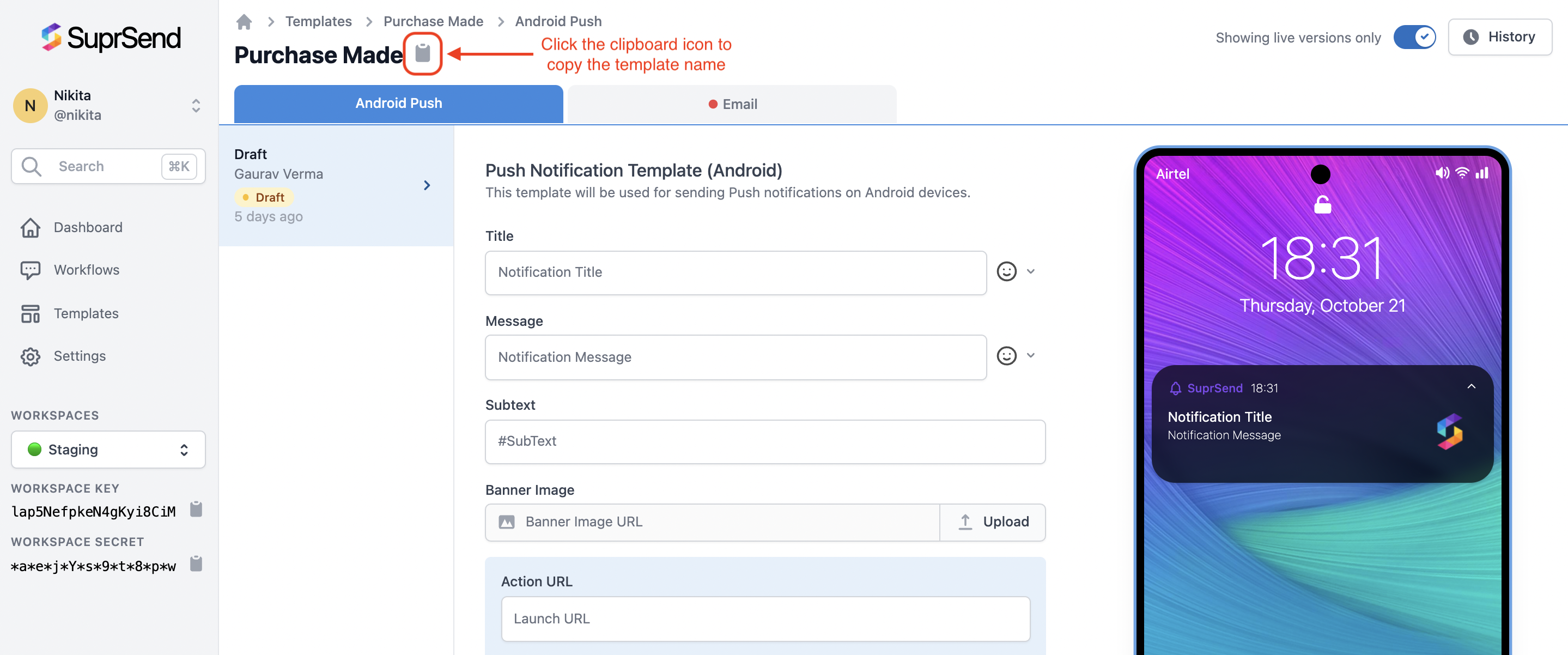
| **`template`** | It is the unique slug name of the template created on the SuprSend platform. You can get this slug name by clicking on the clipboard icon next to the Template name on the SuprSend templates page. It is the same for all channels. | **`slug name`** | *Mandatory* |
| **`notification_category`** | You can understand more about them in the [Preference Category](https://docs.suprsend.com/docs/notification-category) documentation. | `system` / `transactional` / `promotional` | *Mandatory* |
| **`delay`** | Workflow will be halted for the time mentioned in delay and become active once the delay period is over. | `XXdXXhXXmXXs` or if it's a number (n), then delay is in seconds (n). | *Optional* |
| **`trigger_at`** | Trigger workflow on a specific date-time. | Date string in ISO 8601 format for example `"2021-08-27T20:14:51.643Z"` | *Optional* |
| **`users`** | Array object of target users. At least 1 user is mandatory.`distinct_id` for each user is mandatory. Channel information is non-mandatory (If you have already sent channel information via backend or Frontend SDK (on app or website)).Notification will be sent only to the channels defined in workflow if channel information is added. | `json"users": [ { "distinct_id": "value", "$channels": [], "channel_information_dict" #(optional) }]` | *Mandatory* |
| **`delivery`** | Delivery instructions for the workflow. You can set [Smart Delivery](/docs/smart-delivery#smart-channel-routing) preference by setting `"smart":true`.By default, delivery instruction will be: `json"delivery": { "smart": false, "success": "seen"}` | `jsondelivery: { "smart": True/False, "success": "delivered/seen/interaction/", "time_to_live": "", "mandatory_channels": [] # list of mandatory channels e.g "notification",}` | *Optional* |
| **`data`** | JSON object. To replace the variables in the template. Templates use [`handlebars.js`](https://handlebarsjs.com/guide/) language. | `json"data": { "key": { "key": "value", "key": "value" }}` | *Optional* |
| **`brand_id`** | `Brand_id` of the tenant to trigger notifications on behalf of your tenants. | *string* | *Optional* |
| **`idempotency_key`** | Unique key in the request call for [idempotent requests](https://docs.suprsend.com/docs/node-trigger-workflow-from-api#idempotent-requests). | *string* | *Optional* |
For setting `$sms` and `$whatsapp`, `+` is mandatory to send along with phone number. Eg: +1 for US
 #### Bulk API for triggering multiple workflows
Bulk API allows you to send multiple workflow requests in a single call. There isn't any limit on number-of-records that can be added to bulk\_workflows instance. Use `.append()` on `bulk_workflows` instance to add however-many-records to call in bulk.
```javascript Request theme={"system"}
const { Workflow } = require("@suprsend/node-sdk")
const bulk_ins = supr_client.bulk_workflows.new_instance()
// one or more workflow instances
const workflow1 = new Workflow({...}) // body must be a proper workflow request json/dict
const workflow2 = new Workflow({...}) // body must be a proper workflow request json/dict
// --- use .append on bulk instance to add one or more records
bulk_ins.append(workflow1)
bulk_ins.append(workflow2)
// OR
bulk_ins.append(workflow1, workflow2)
// -------
const response = bulk_ins.trigger()
response.then((res) => console.log("response", res));
```
```javascript Response theme={"system"}
// Response structure
{
status: "success",
total: 10, // number of records sent in bulk
success: 10, // number of records succeeded
failure: 0, // number of records failed
failed_records: [],
warnings: []
}
{
status: "fail",
total: 10, // number of records sent in bulk
success: 0, // number of records succeeded
failure: 10, // number of records failed
failed_records: [{"record": {...}, "error": "error_str", "code": 500}],
warnings: []
}
{
status: "partial",
total: 10, // number of records sent in bulk
success: 6, // number of records succeeded
failure: 4, // number of records failed
failed_records: [{"record": {...}, "error": "error_str", "code": 500}],
warnings: []
}
```
***
#### Bulk API for triggering multiple workflows
Bulk API allows you to send multiple workflow requests in a single call. There isn't any limit on number-of-records that can be added to bulk\_workflows instance. Use `.append()` on `bulk_workflows` instance to add however-many-records to call in bulk.
```javascript Request theme={"system"}
const { Workflow } = require("@suprsend/node-sdk")
const bulk_ins = supr_client.bulk_workflows.new_instance()
// one or more workflow instances
const workflow1 = new Workflow({...}) // body must be a proper workflow request json/dict
const workflow2 = new Workflow({...}) // body must be a proper workflow request json/dict
// --- use .append on bulk instance to add one or more records
bulk_ins.append(workflow1)
bulk_ins.append(workflow2)
// OR
bulk_ins.append(workflow1, workflow2)
// -------
const response = bulk_ins.trigger()
response.then((res) => console.log("response", res));
```
```javascript Response theme={"system"}
// Response structure
{
status: "success",
total: 10, // number of records sent in bulk
success: 10, // number of records succeeded
failure: 0, // number of records failed
failed_records: [],
warnings: []
}
{
status: "fail",
total: 10, // number of records sent in bulk
success: 0, // number of records succeeded
failure: 10, // number of records failed
failed_records: [{"record": {...}, "error": "error_str", "code": 500}],
warnings: []
}
{
status: "partial",
total: 10, // number of records sent in bulk
success: 6, // number of records succeeded
failure: 4, // number of records failed
failed_records: [{"record": {...}, "error": "error_str", "code": 500}],
warnings: []
}
```
***