> ## Documentation Index
> Fetch the complete documentation index at: https://docs.suprsend.com/llms.txt
> Use this file to discover all available pages before exploring further.
# Slack Agent
> Manage SuprSend users, workflows, preferences, and analytics from Slack DMs and channels with a Privacy Filter that keeps PII out of shared rooms.
Slack Agent brings SuprSend Agent into your Slack workspace. Look up profiles, trigger workflows, change preferences, pull delivery analytics, and ask product questions, all from a DM or channel.
Two things to know before you install:
* **Privacy Filter on by default.** PII never lands in a searchable channel by accident. Sensitive identifiers are routed to the requester's DM; the channel sees a summary. See [Privacy Filter](#privacy-filter) below.
* **AI is optional.** SuprSend's notification stack (workflows, templates, channels, preferences, delivery, analytics) does not depend on AI. If your organization can't share data with third-party model providers, an admin can disable every AI feature in one click. See [Settings](#settings).
Slack Agent is in **beta**. Behavior and channel coverage may change. Use a private test channel for experiments before relying on it in production threads.
***
## Quick start
1. **Install the Slack App** for your workspace from **Account Settings → [AI & Agents](https://app.suprsend.com/en/account-settings/ai-agents)**. Your SuprSend admin can share the install link.
2. After install, **`@SuprSend`** appears as a regular bot user in your workspace. DM it or invite it to any channel.
3. Start asking:
* In a channel: type **`@suprsend`** followed by your request.
* In a DM: open a direct message with **`@SuprSend`** and just type.
```text theme={"system"}
@suprsend show the profile for user_123
@suprsend trigger order-confirmation for jane@acme.com
@suprsend what was our email open rate last week?
```
***
## Privacy Filter
Slack channels are searchable, exportable, and often shared with broader audiences than the people who originally asked. A teammate posting *"what's [jane@acme.com](mailto:jane@acme.com)'s phone number?"* into `#growth` shouldn't leak that number to everyone with channel history access.
The **Privacy Filter** is Slack Agent's default behavior in channels. It detects when a response would contain PII (emails, phone numbers, push tokens, device identifiers, channel addresses) and splits the reply:
* The **channel** sees a non-sensitive summary in-thread (e.g., *"Found the profile for user\_123. Sent identifiers to your DM."*).
* The **requester's DM** receives the raw identifiers, so the person doing the work still gets what they need.
DMs are inherently private, so the filter doesn't apply there. Full identifiers are returned inline.
| Surface | When to use it | What the Privacy Filter does |
| ------------------- | ------------------------------------------------------------------------------------------------------------------- | ------------------------------------------------------------------------------------------------ |
| **Direct messages** | Private lookups, work tied to a specific user, anything involving identifiers, channel addresses, or device tokens. | Inactive. Emails, phone numbers, push tokens, and other PII are returned in full. |
| **Channels** | Team-visible work, like analytics summaries, workflow audits, debugging in front of teammates. | **Active by default.** PII is stripped from the channel reply and DM'd to the requester instead. |
The filter runs at the response layer, not the prompt layer. Teammates can still ask sensitive questions in channels; the filter just makes sure the answer doesn't expose PII in a place it shouldn't live.
For organizations that don't want any prompt or response data leaving SuprSend, the AI layer (Slack Agent included) can be disabled entirely from [AI & Agents](https://app.suprsend.com/en/account-settings/ai-agents). See [Settings](#settings) below.
***
## What Slack Agent can help with
Fetch user profiles, preferences, and object or tenant configuration. List workflows, templates, and events.
Create or update users and objects. Manage channel addresses (email, SMS, push, Slack, and others). Update notification preferences. Add or remove users from subscriber lists or object subscriptions.
Trigger API-triggered workflows. Track events so event-triggered workflows can run.
Query notification delivery stats, engagement rates, and workflow execution counts. Ask for trend summaries or charts for breakdowns over time.
Trace why a notification didn't land for a user. Channels attempted, preferences applied, overrides hit, and execution logs in one explanation.
Get answers about how SuprSend works. APIs, SDKs, channels, templates, workflows, preferences, and related concepts.
***
## Example prompts
Slack Agent works best when prompts include a clear identifier (user distinct ID, object ID, workflow slug, tenant key). Paste these in, swap your own values, and send.
**Users and preferences**
```text theme={"system"}
@suprsend Show the profile and preferences for user distinct_id "user_123".
@suprsend Why isn't jane@acme.com getting emails for the payment-reminder workflow?
@suprsend Opt user_456 out of the product-updates category.
```
**Workflows and events**
```text theme={"system"}
@suprsend List workflows in this workspace and summarize what each one does.
@suprsend Trigger the order-confirmation workflow for user jane@acme.com with a sample payload.
@suprsend Track a checkout-completed event for user_123 with order_id "ORD-9912".
```
**Analytics**
```text theme={"system"}
@suprsend What were our email delivery and open rates last week?
@suprsend Break down WhatsApp delivery by tenant for the last 30 days.
```
**Documentation**
```text theme={"system"}
@suprsend How do tenant default preferences interact with user-level overrides?
@suprsend What's the difference between objects and lists in SuprSend?
```
***
## Settings
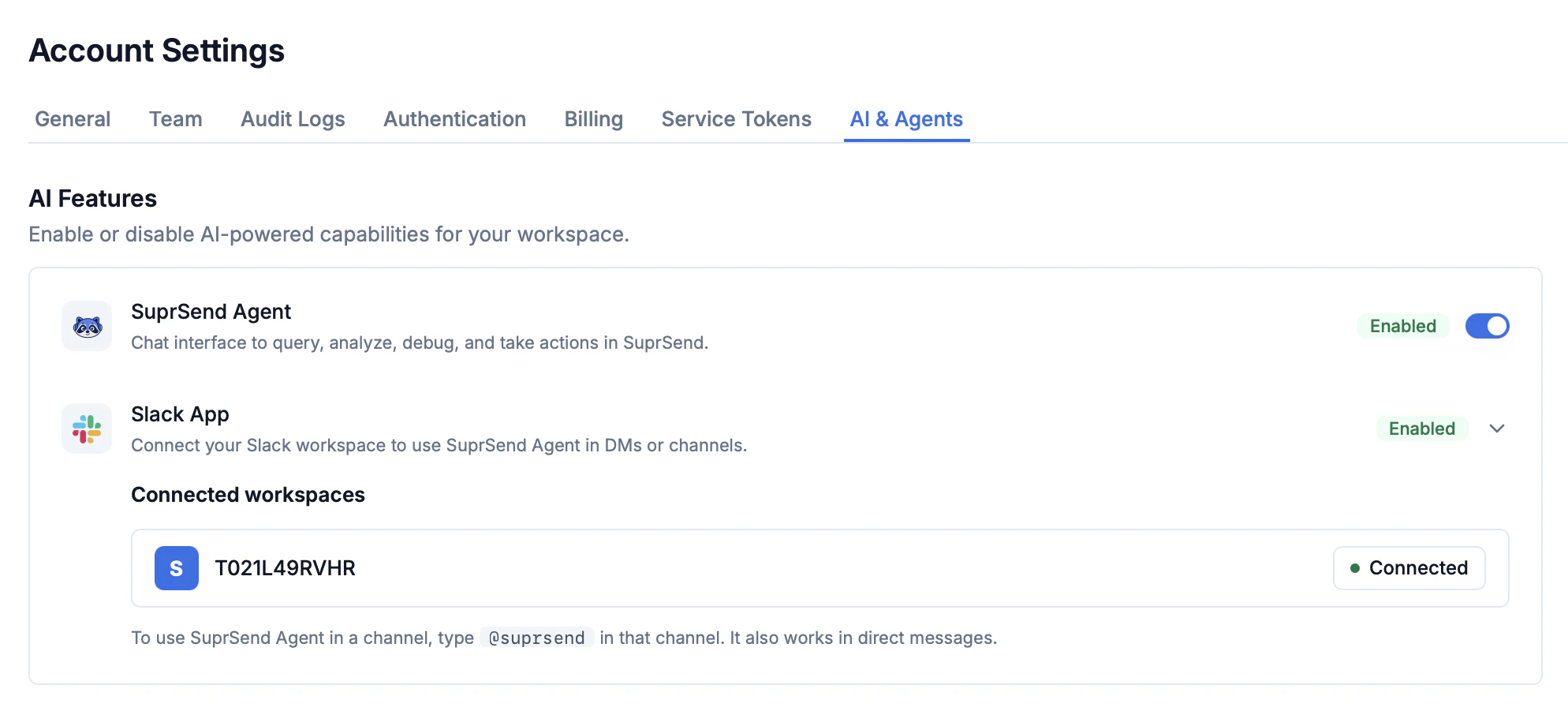
Slack App setup lives on the same page as the dashboard Agent: **Account Settings → [AI & Agents](https://app.suprsend.com/en/account-settings/ai-agents)**.
Installing, connecting, disconnecting, and toggling the Slack App is **admin-only**. Once an admin connects the workspace, anyone in Slack whose email matches a SuprSend user can DM `@SuprSend` or tag it in a channel, scoped to their own SuprSend role and tenants.
From the settings page, an admin can:
* Install, connect, or disconnect the Slack workspace.
* Toggle the Slack App on or off. Disabling stops Slack Agent from responding in any channel or DM, but preserves install state so re-enabling does not require re-authorizing.
* Turn off all AI features at the workspace level if your organization opts out of third-party model usage. SuprSend's notification infrastructure continues to work with AI disabled.
* View Slack-attributed credit usage alongside the rest of your AI consumption.
 ### AI usage
Slack Agent shares the same credit pool as the dashboard Agent. The settings page shows credits used vs. total for the current cycle, with a per-capability breakdown so you can see how much of your usage is coming from Slack.
### AI usage
Slack Agent shares the same credit pool as the dashboard Agent. The settings page shows credits used vs. total for the current cycle, with a per-capability breakdown so you can see how much of your usage is coming from Slack.
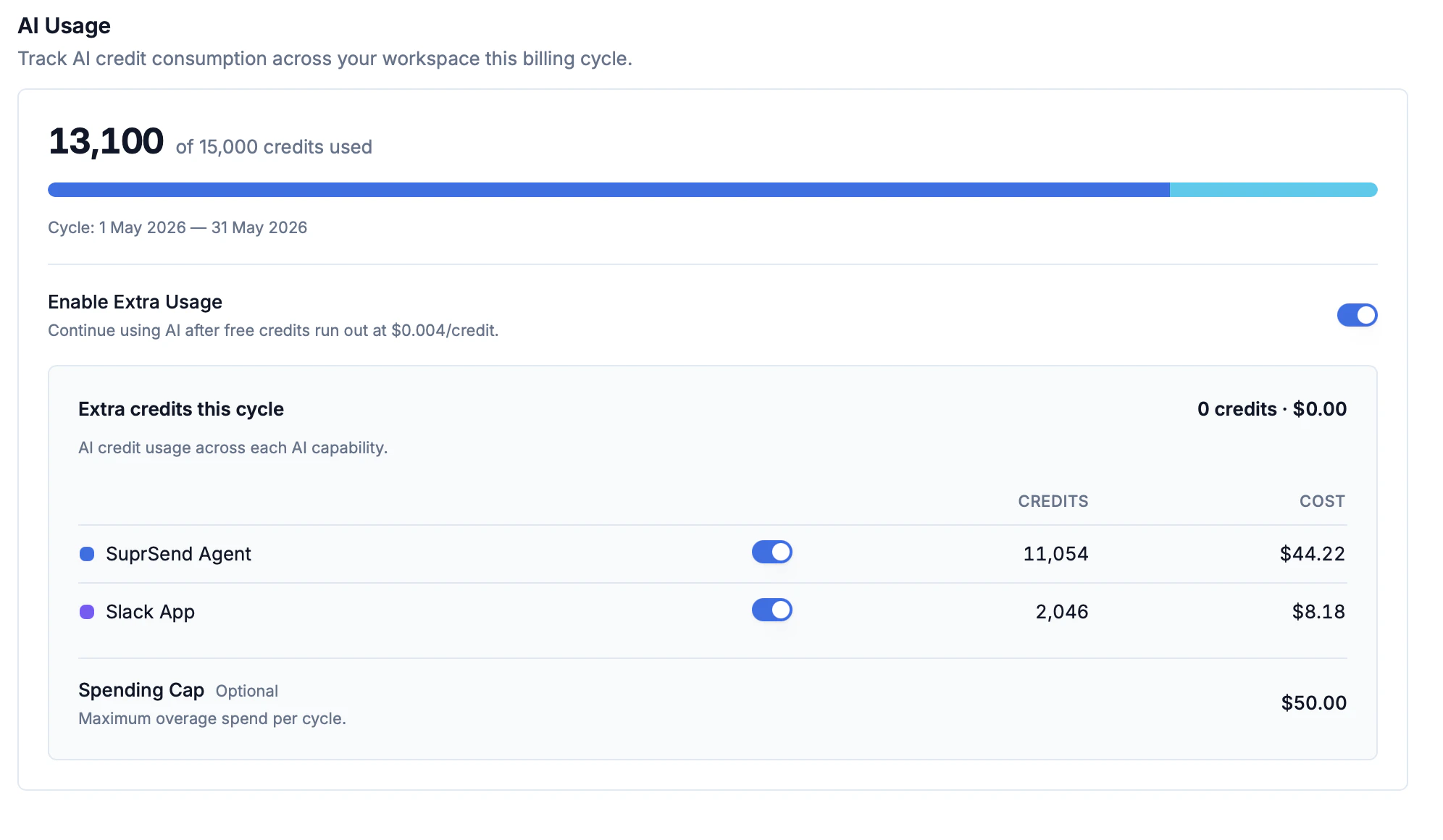 For details on plan allowances, overage rates, and Extra Usage, see [Agent → AI Usage and credits](/reference/agent#ai-usage-and-credits).
***
## Related
The same workspace tools from inside the SuprSend dashboard. Useful when you're not in Slack.
Model Context Protocol for IDEs. Complementary to chat agents for developers.
For details on plan allowances, overage rates, and Extra Usage, see [Agent → AI Usage and credits](/reference/agent#ai-usage-and-credits).
***
## Related
The same workspace tools from inside the SuprSend dashboard. Useful when you're not in Slack.
Model Context Protocol for IDEs. Complementary to chat agents for developers.