Step-by-step guide to creating, editing, testing, and managing SuprSend notification templates across email, SMS, push, Slack, WhatsApp, and inbox channels.
From the Templates page - go to Templates in the sidebar and click + New Template. You’ll link it to a workflow later.
From a workflow - click Create Template inside a delivery node in the workflow builder. The template is automatically linked to that workflow and its name and slug are pre-filled from the workflow and node names. This is the fastest path when building a new notification from scratch.
1
Click + New Template
From the Templates page or a workflow node, open the creation modal.
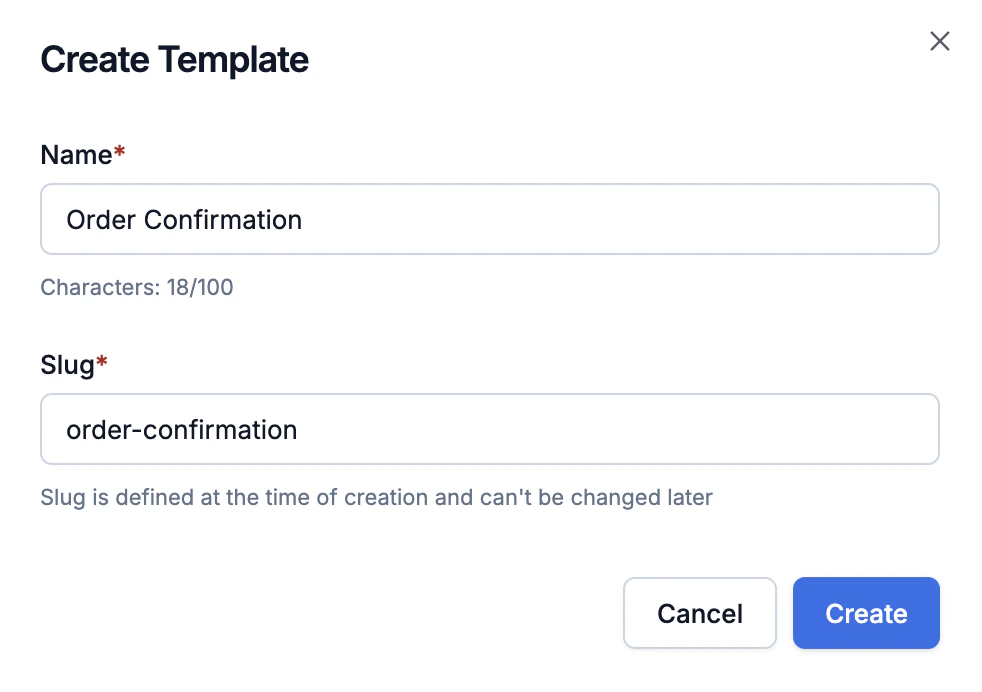
Create Template - Name and Slug
Enter a Name (display label, changeable later) and a Slug (the identifier your workflow uses to reference this template - auto-derived from the name, cannot be changed after creation). Renaming the template later doesn’t affect the slug, so existing workflows keep working.
2
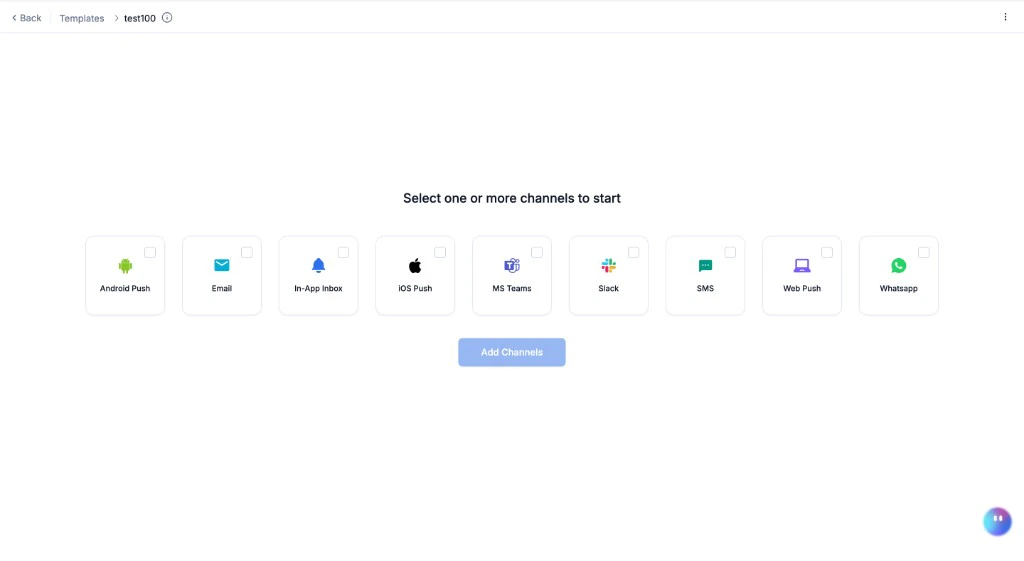
Pick channels
Select the channels you want to send on. You can add more channels later by clicking the + tab in the editor, or remove a channel from the channel’s three-dot menu.
The editor opens for your first channel. Each channel has its own editor with a live device preview on the right. Click the channel tabs at the top to switch between them.
View mode (default) - shows the published version, read-only.
Edit mode - click Edit to open the draft. Content auto-saves as you type. Live traffic is never affected until you commit. If you exit without committing, your draft is saved - you can come back and pick up where you left off.
For channel-specific fields and editor guides, see:
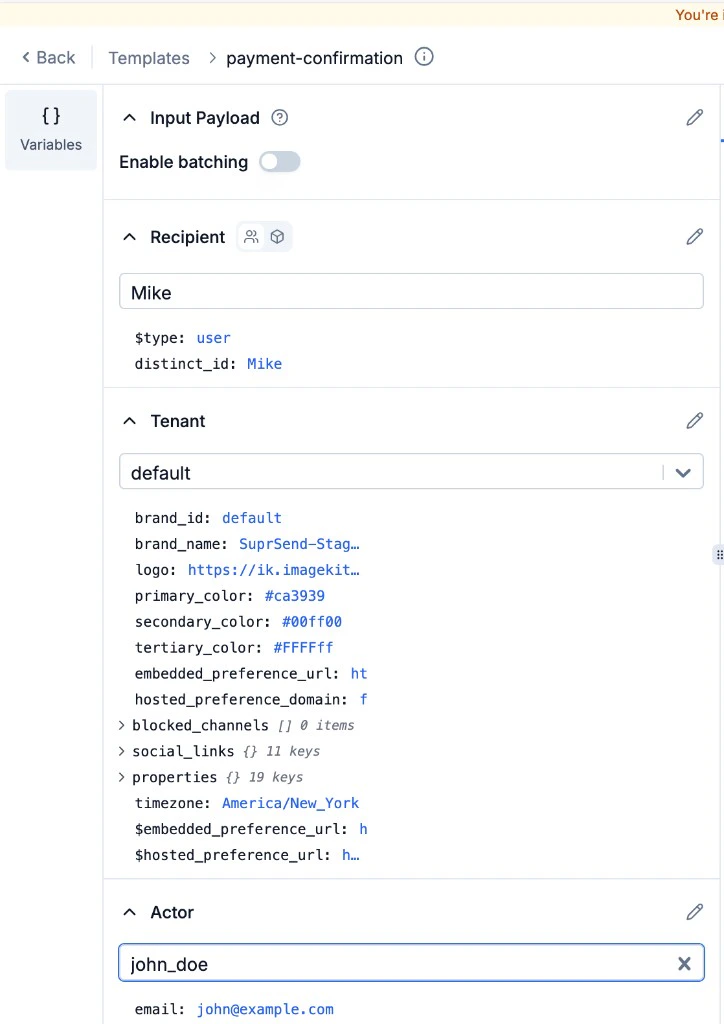
The left panel has a {} tab - the Variables panel. This is where you set up all the data your template uses. It powers auto-suggestions, the live preview, and the test flow. Set this up before writing variables in your content.
Variables panel
Input PayloadThis is the data your workflow trigger sends - order details, event info, URLs, etc. Paste a sample JSON that matches the shape of your actual trigger payload. For example:
Use these in your template as {{order_id}}, {{order.address.city}}, {{{tracking_url}}} (triple braces for URLs to avoid escaping &, ?, =).Toggle Enable batching to preview batched/digest content - this adds $batched_events and $batched_events_count to your data context.You can also click Pre-fill from last workflow run (if the template is linked to a workflow) to auto-populate with real data from the most recent trigger.RecipientSearch for a user by name, email, or distinct ID. Their profile properties load into $recipient - accessible in your template as:
{{$recipient.name}} - user’s name
{{$recipient.email}} - user’s email
{{$recipient.phone}} - user’s phone number
{{$recipient.distinct_id}} - user’s unique ID
Any custom property you’ve set on the user profile
This is the person who receives the notification. In the live preview, selecting a recipient renders the template with their actual data - so you can see exactly what they’d receive.
Use $recipient in templates, not $user. Both refer to the same data, but $recipient is the standard.
TenantSelect a tenant from the dropdown. Its properties load into $tenant - accessible as:
{{$tenant.name}} - tenant’s display name
{{$tenant.logo}} - tenant’s logo URL
{{$tenant.primary_color}} - brand colour (used in email Tenant blocks)
{{$tenant.properties.address}} - custom tenant properties (address, support email, etc.)
{{$tenant.$hosted_preference_url}} - hosted unsubscribe/preference page link
{{$tenant.$embedded_preference_url}} - embedded preference widget link
If your template uses tenant branding (logo in email header, brand name in SMS, etc.), selecting a tenant in the preview shows you exactly how that tenant’s notifications look.ActorThe actor is the person who performed the action that triggered the notification - separate from the recipient. For example: “Alice commented on Bob’s post” - Alice is the $actor, Bob is the $recipient.
{{$actor.name}} - actor’s name
{{$actor.email}} - actor’s email
Actor data is only available when your workflow trigger includes an actor. If no actor is passed, $actor variables render as empty.
Once your data is set up, type {{ in any text field - a dropdown shows all available variables grouped by source (Input Payload, Recipient, Actor, Tenant). Pick one, and it renders instantly in the preview. Variables with missing values are highlighted in red.In the Email Design Editor, use the Merge Tags button in the toolbar instead.For advanced logic (conditionals, loops, date formatting), see Handlebars Helpers. For Slack and MS Teams (JSONNET syntax), see JSONNET Templates.The live preview on the right updates as you type. Select different Recipients and Tenants in the Variables panel to see how the template renders for different users and brands.
Click Commit in the top bar to publish your draft. Add an optional description. All future workflow triggers immediately use the new content.For WhatsApp and SMS (DLT), committing puts the version into Approval Pending - it goes live only after vendor approval.
Once committed, the template is ready to be used. Add it to a workflow delivery node by referencing its slug. Every time the workflow triggers, SuprSend renders the template with the trigger payload and sends it to the recipient. You can copy the slug from the clipboard icon next to the template name.
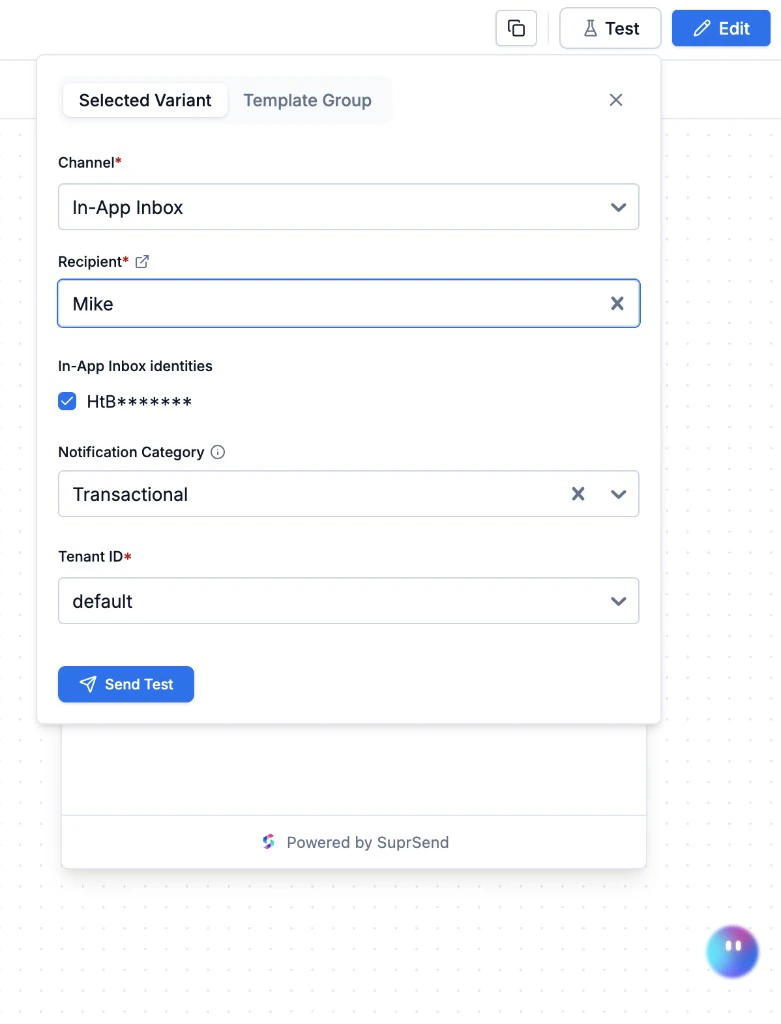
Send a real notification to a real device to verify everything looks right end-to-end. In the editor, Test sends your current draft; from the live view, it sends the live version.Click the Test button in the top-right corner.
Need a test user? You need a user with at least one channel identity (email, phone number, device token). Create one from the Users page, via API, or ask Agent in the dashboard to create one.
Test one channel
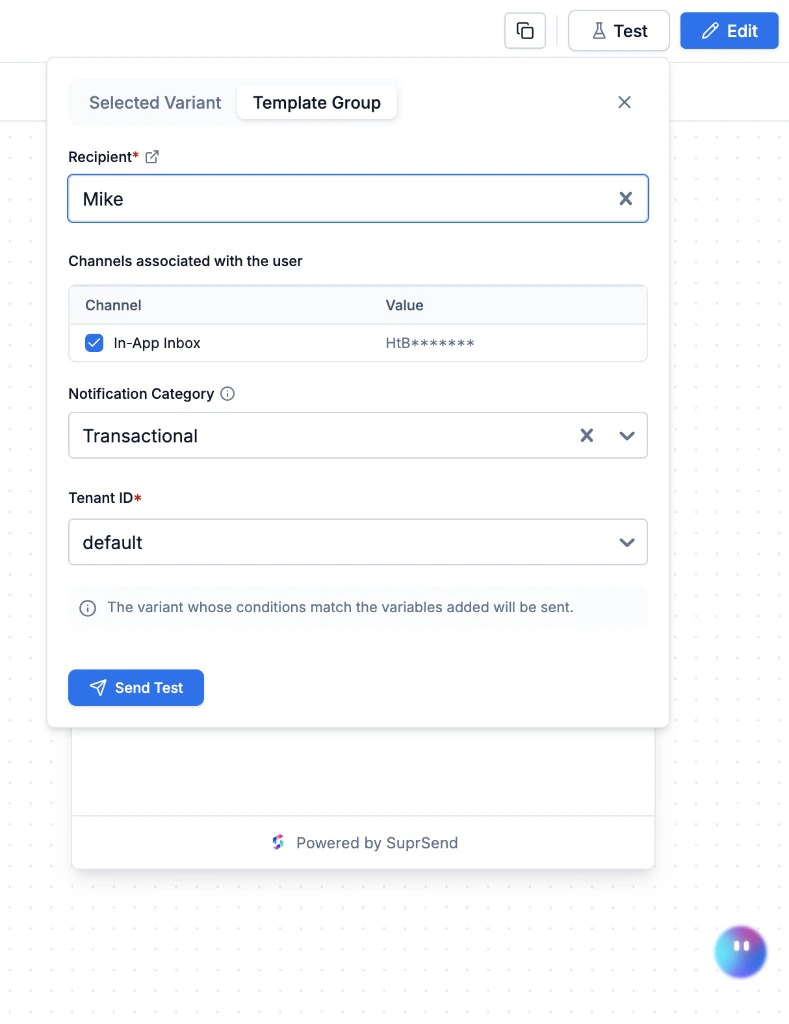
Test all channels
Pick the Channel (for example, Email, SMS).
Enter a Recipient (email or distinct ID).
Pick the Notification Category (required, defaults to Transactional) — determines which vendor config is used (for example, transactional vs promotional SMS vendor).
Optionally pick a Tenant — loads that tenant’s branding into $tenant and selects the matching tenant variant. Leave blank to use defaults.
Click Send Test.
Test one variant on one channel
Enter a Recipient - the panel shows every channel that user has identities for.
Check the channels to include.
Pick the Notification Category (required, defaults to Transactional) and optionally a Tenant.
Click Send Test.
Test all channels at once
After sending, go to Logs to check delivery status. If a variable was missing or a channel failed to render, you’ll see the exact error there.
WhatsApp and SMS (DLT) templates must be committed and approved before you can test.
Every template starts with a default variant. That’s enough for most use cases. Add more variants only when you need different content for different audiences:
Languages — a Spanish variant for Spanish-speaking users, Hindi for Hindi. SuprSend auto-selects based on the recipient’s preferred language. See Multi-lingual Templates.
Tenants — Uber’s users see Uber branding, Acme’s users see Acme’s. One template serves all tenants.
Payload conditions — show different content based on trigger data (for example, plan == "pro" gets a premium message).
Non-default variants are evaluated in order - the first one whose conditions match is sent. If nothing matches, the default variant (always at the top) is sent as the fallback. Name them descriptively: uber-en, acme-es, default-hi.Full guide: Template Variants.
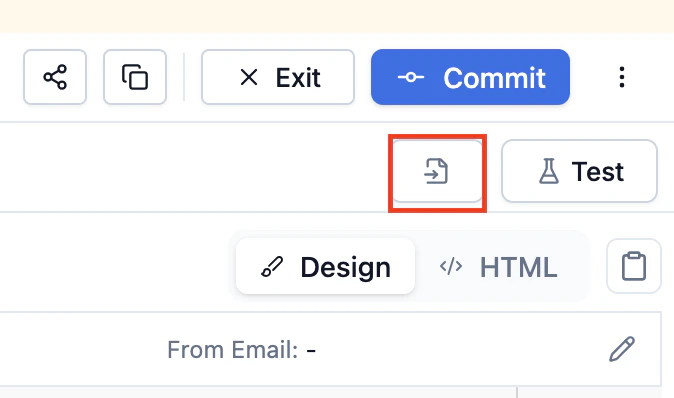
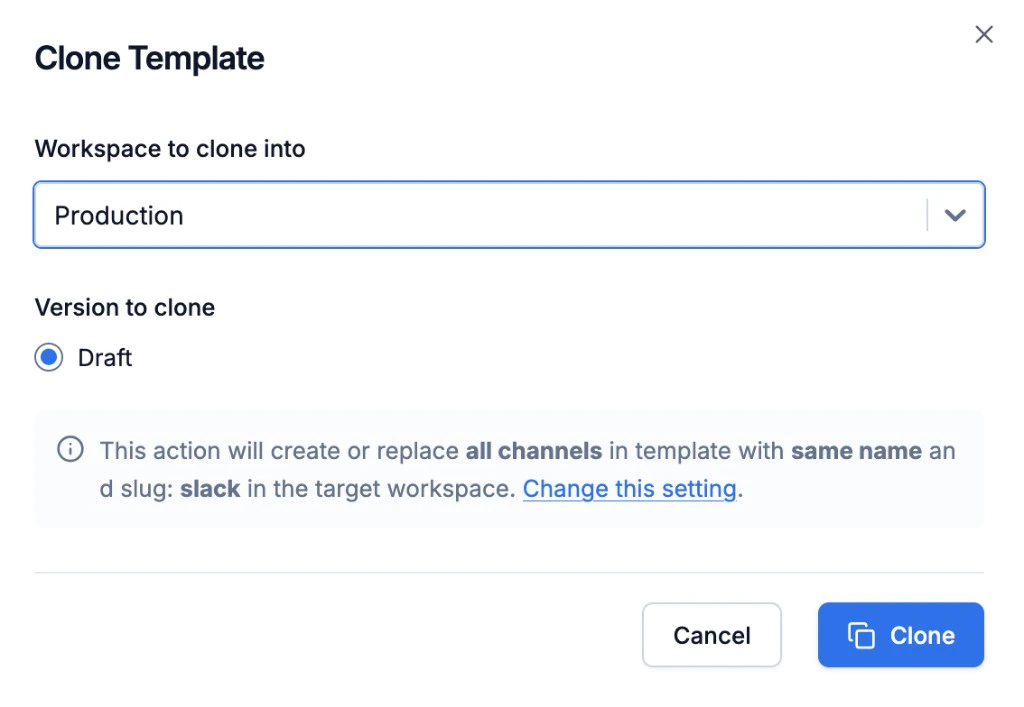
Click Clone Template to copy the entire template (all channels, variants, content) to the same or a different workspace — for example, from Staging to Production.
Metadata - click the info icon next to the template name to edit Name, Description, and Tags. The Slug is immutable after creation.Finding templates - the Templates listing page shows all templates with status, channels, linked workflow, and last updated. Use Filters and Sort to narrow by channel, tag, status, or templates you edited. The Approvals tab shows pending WhatsApp/DLT approvals.Archive - archive unused templates from the overflow menu. Cannot be recovered.API and CLI - manage templates programmatically via the Template Management API or CLI.